
In the past couple days, videos have circulated showing Tucker Carlson visiting with Gazan refugees in Qatar, and decrying Israel’s murder of tens of thousands of children amidst its ongoing genocide in Gaza. “Part of the reason the warmonger right hates Tucker is because he has a conscience. They would love to live without one,” enthused liberal commentator Zain Jilani. I’ve heard variations on the same theme from many leftists— of course he’s a fascist, but good on him for really caring. We shouldn’t be fooled.

It is disorienting to watch MAGA figures like Tucker Carlson and Marjorie Taylor Greene suddenly drape themselves in the language of human rights, speaking with apparent moral clarity about Israel’s genocide in Gaza and Palestinian suffering. The same leaders who revel in cruelty toward immigrants, trans people, Black Lives Matter protesters, and almost every marginalized group now sound, for a moment, like Amnesty International.
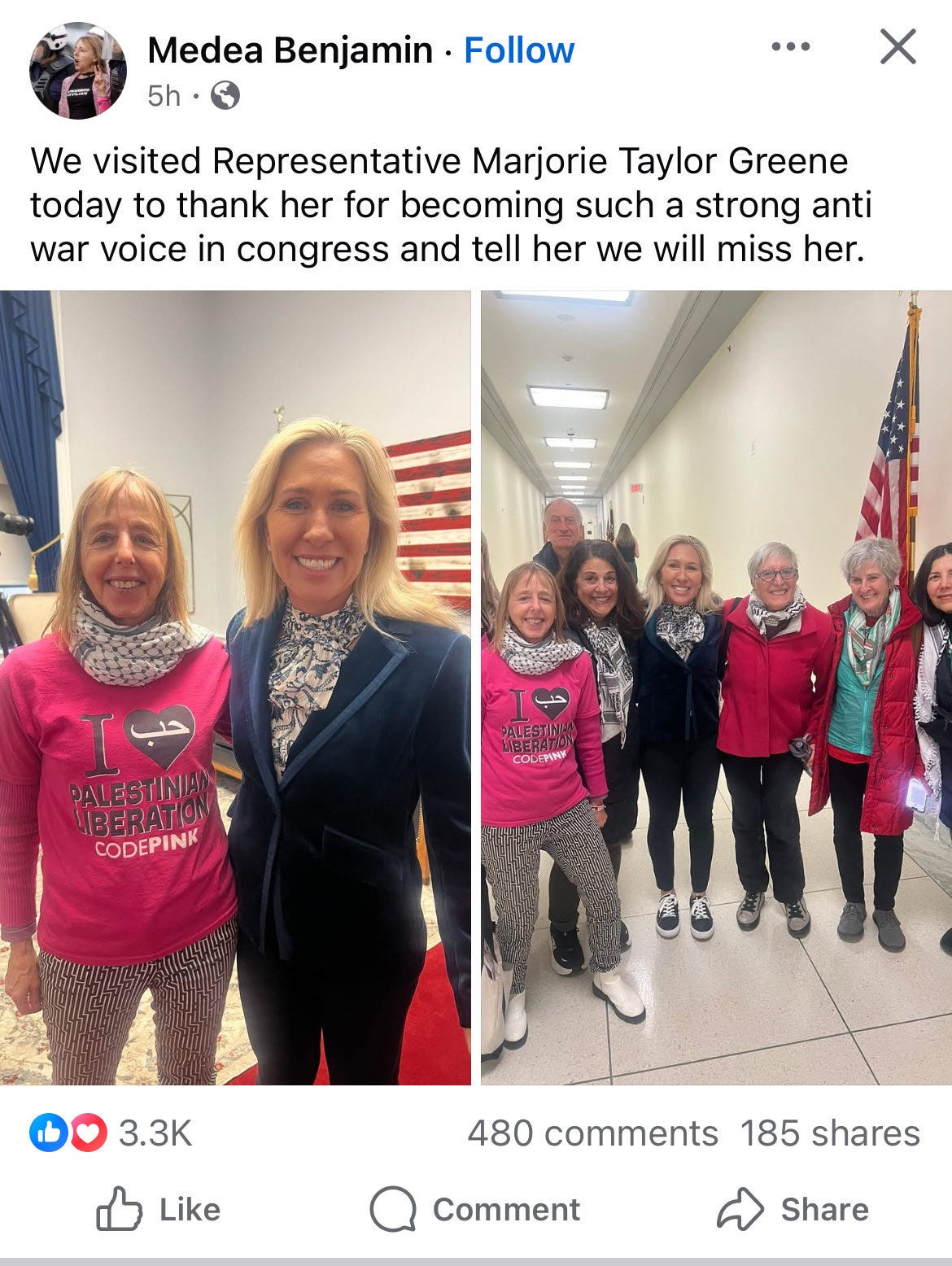
Amidst our vertigo, some progressives think there is tactical value in partnering with the Israel-critical Right around narrow, shared goals of ending the carnage in Gaza, opposing new U.S. weapons transfers, or reining in the national security state. Progressive members of Congress have co-sponsored or voted with MTG or Thomas Massie on specific measures, while CodePink even recently posed for a photo with Greene in Congress, thanking her for her stance. I often think these alliances are ill-advised beyond a few specific contexts, where they should be approached with caution and careful deliberation, but the deeper strategic questions this opens up are beyond the scope of this piece.
Here I want to make the point that confusion about motives can scramble our political coordinates. Israel-critical MAGA elites like Carlson are wielding selective empathy for Palestine as a political weapon in an inter-elite struggle over the future of the Right. Their public sympathy for Palestinians helps score rhetorical points against the pro-Israel neoconservative old guard and lends moral legitimacy to their emergent “America First” nationalist bloc, which rejects Middle East intervention while doubling down on white Christian nationalism at home.
The point is not what is in Tucker’s heart, but what his tears are doing in the broader strategic landscape.
Western elites have long weaponized selective empathy for oppressed groups in their internecine squabbles. In the build-up to the Iraq War, neoconservatives—including Tucker himself, at the time—invoked the suffering of Iraqi women and children under Saddam Hussein to justify invasion and occupation. Today, those same pro-Israel forces highlight the persecution of Christians in the Middle East to cast Israel as a beleaguered outpost of “Judeo-Christian civilization.” Carlson broke ranks with his old friends but kept their tactics: he regularly highlights the real struggles of Palestinian Christians under Israeli occupation and genocide in order to fracture the ‘Judeo-Christian’ consensus on the Right, often implicitly mobilizing centuries-old Christian polemics against Judaism in the process.
There is nothing new about these tactics. When Britain ruled over Palestine in the early 20th century, colonial officers and senior officials sympathetic to Zionist aspirations invoked Arab ‘fanaticism’ and Jewish victimhood, while those who favored Arab nationalism (and sometimes, even British withdrawal) condemned Zionist aggression and expressed outrage at Palestinian dispossession. No matter which direction they aimed their public grief, they remained hard-nosed imperialists, maneuvering to secure the most favorable conditions for the domination of their Empire, and their humanitarian sympathy rarely extended across its myriad other frontiers.
Ironically, if we’re looking for contemporary examples of selective empathy wielded for political ends, we need look no further than the pro-Israel anti-antisemitism Carlson so effectively critiques. The nonstop performative October 7 memorialization, and self-serving concern for Jewish vulnerability on college campuses expressed by those seeking endless war in the Middle East or the authoritarian dismantling of American higher education— all show the dangers of useful victim narratives. (Nor are selective empathy and performative allyship the exclusive province of the Right, of course— indeed these tendencies may be constitutive of our political discourse across the spectrum.)
In a media ecosystem saturated with wall-to-wall dehumanization of Palestinians, we may welcome any platform which manages to break through the noise. We should just recognize that Tucker Carlson is deploying a rival affective regime, rather than applauding him as a voice of conscience. We don’t know what’s in Tucker’s heart, and it doesn’t matter. Political actors frequently come to believe their own selective empathy; sincerity and instrumentalization are not mutually exclusive. The question is not “is this emotion real?” but “what work is it doing, and for whom?” We may well decide that even the most selective, self-serving empathy should be encouraged as a wedge that can open fissures in reactionary coalitions. But we shouldn’t be fooled, even for a moment, that these people are our friends.
The Palestine freedom movement loses more than it gains from associating with Tucker Carlson. Right wing ideologues are not interested in universal rights, freedom and equality. The Palestinian freedom movement is always under attack by those who argue that it is antisemitic. Associating with someone who is friends with a real antisemite like Nick Fuentes gives rhetorical fuel for those trying to discredit pro-Palestine advocacy as antisemitic.
Racists of the world unite! You have nothing to lose but your freedom.
Of course, there will be an alliance with antisemitic right populism. Just as Stalin allied with Hitler, abtizionism will unite with all totalitarian movements in its war against the Jews.